
Fish Tail
- Apr 2
- 2 min read
A Fish tail is clearly a form of Swallow Tail, but it is as distinctive as the “Fish” model surfboards that you will find it on. It is generally much wider and deeper than other Swallow Tails, creating a parallel rail from in front of the wide point, all of the way to the end of the tail.
I have included full images of our current Fish models, so that we could see the differences as we move from “old school” to “new school” from left to right.
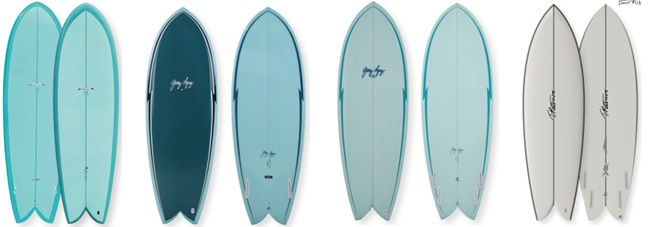
Takayama Humu Fish
On the left, we have the Takayama Humu Fish, as you can see the nose is very wide and rounded, and the tail is also very wide. The swallow tail is very deep and rounded, with the outside rails being very straight and parallel. This creates a very long and drawn-out turning arc, which equates to speed, especially in small, soft, mushy waves, where it is typically difficult to generate speed. The rocker of the board is also very flat, with low entry and tail rocker, this also adds to the speed of the board in small surf. The fin set-up is dedicated Twin Fin only, and you will find that a board like this is designed to be ridden with Keel Fins (See Fin Section) as they have a very wide base, which creates forward thrust, while giving up the looseness of a narrower based fin. It can also be ridden with standard Twin Fins (again see Fin Section), which will give it a sharper turning radius.
Something Fishy- Twin
Next, we have the Gerry Lopez “Something Fishy.” It comes in two fin configurations and two construction material variations. The first one (second from left) is a dedicated Twin Fin setup, just like the Humu Fish above. All of the comments above also apply here, but you will notice that the outline of the board is slightly different. It has a sharper nose, which creates a bit more curvature along the rail line, from nose to tail. This will make the board a bit looser turning than the Humu, but still very similar, as it is intended to be. Also, both of Gerry’s variants have truly progressive and modern bottom contours.
Something Fishy-Quad
Then comes Gerry’s “Something Fishy” with a Quad (4 Fin) setup. Same exact shape, but designed to be ridden as a quad, making it looser than a Keel Fin, but a bit more drive than a standard Twin Fin setup. This is a good compromise for a more modern surfing approach, on a traditionally outlined fish, but with those awesome bottom contours.
Devil Fish
Finally, we come to Timmy Patterson’s “Devil Fish.” Aptly named, as it is quite the demon! A more pulled nose, but a wide and deep tail and a Quad setup. This is an effective hybrid between a standard fish, and a modern shortboard. The modern bottom contours on this board make it a true performance board.
If you read the shaper’s information provided on all of these boards in the catalog, you will understand the different philosophies of the shapers, and their intentions. Personally, I have been riding Fish boards since the 1970’s, and I LOVE them.
About Author-
Comments